
Counseling Career Path: Required Education and Licensures’ Explained

This post contains affiliate links, which means I’ll receive a commission if you purchase through my links, at no extra cost to you. Please read full disclosure for more information.
A while back, I went to a career day at a high school and spoke about getting into the mental health private practice field. To high schoolers, the road there may have seemed long, with four years for a Bachelor’s and then two–three years for Master’s and then another two or more years to get licensed. Even though a lot of school may be involved, there are so many other skills to learn along the way and so many creative, entrepreneurial opportunities that many are not aware of.
Whether you are still in high school figuring out what road to take or already have a Master’s working in an agency, here are some basic steps to become a licensed therapist and to open a mental health private practice.
If you are looking for the best tools, websites and products that I’ve used to build a mental health private practice head over here.
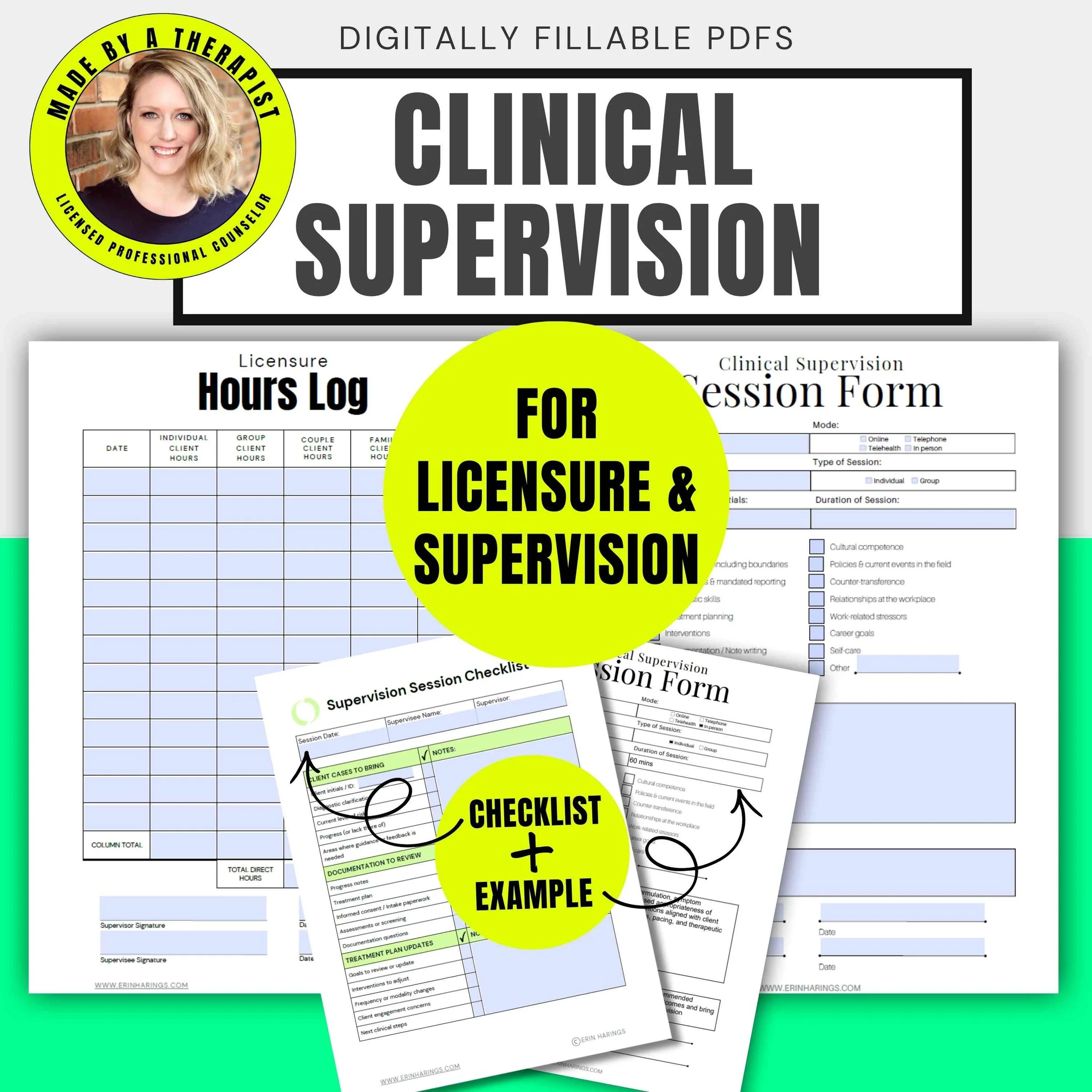
This clinical supervision session form and supervision hours log is the perfect template to use for supervisors to track face to face hours. With our easy-to-use worksheets, you'll be able to stay on top of your supervision requirements and ensure that you're providing the best possible care for your clients.
✔ What’s Included
• Clinical Supervision Session Form
•Licensure Hour Tracker
BONUSES INCLUDED:
✔ Filled-In Clinical Supervision Example
✔ Supervision Session Prep Checklist
PDF - US Letter Size 8.5 x 11 in.
Unlimited Printing! (per one therapist)
Purchase one for each therapist that uses this form.

The Clinical Hour Tracker will help you stay on top of your hours and progress. This worksheet is easy to use and comes with all the categories you need to track your hours. Categories include Date, Individual, Group, Couple and Family Client Contact Hours. Non-Direct Client Contact Hours. Total Direct Hours & Total Non-Direct Hours
Includes 1 worksheet in a digitally fillable PDF download:
-Clinical Hours Tracker
US Letter Size
Unlimited Use or Printing Per One Person!
This is an instant download!
Education Path
BACHELORS
Any major will do for a bachelors, but there are some prerequisites for getting into some Master's programs, but you don’t NEED to have a degree in psychology or a related field to get into a Master’s program for counseling.
MASTERS
There are various master's programs to choose from, depending on what you want to specialize in. For example, if you want to do couples counseling or family counseling, you may want a program for marriage and family. You can do that type of therapy by doing another program as well. I got my Master’s in School and Community Counseling. I have many coworkers that are social workers and got their Master’s in a social work program. Think of what type of demographic you want to work with when choosing a master's program.
LICENSE
After you complete your Master's program, you’ll have to work on becoming licensed. During this time, you will be working in the field as a therapist, but will need to be directly supervised by someone signing off on your face-to-face hours (usually around 3000) and getting supervision hours in. Once you get all of your face-to-face and supervision hours in, you can take a test to get licensed. Some of the most common licenses are: Licensed Professional Counselor, Licensed Clinical Social Worker, Licensed Marriage and Family Therapist and Licensed Mental Health Counselor.
You can open your own private practice after getting your license. Once you are licensed you are able to bill insurances and do therapy without a supervisor to sign off on your sessions.
What Do All the Different Therapy Licenses Mean?
One of the biggest questions people ask when wanting to become a therapist is: Which license should I get? While all licensed mental health professionals are trained to help people improve their mental health, each license tends to have a different training background and approach.
LMFT (Licensed Marriage and Family Therapist)
Marriage and Family Therapists are trained through a relationship and family-focused lens. They often look at how family dynamics, communication patterns, and relationships impact mental health.
LMFTs commonly work with:
Couples and marriage issues
Parenting challenges
Family conflict
Children and teens
Relationship communication and connection
Even when working with one person individually, they often explore how relationships and family systems affect emotions, behaviors, and stress.
LCSW / MSW (Licensed Clinical Social Worker)
Social Workers earn a Master of Social Work (MSW) degree and are trained to look at the “whole picture” of someone’s life. In addition to therapy skills, they often have strong training in community mental health, advocacy, trauma, crisis work, and support systems.
LCSWs often focus on:
Trauma and crisis support
Community and family systems
Access to resources and support services
Hospital, school, and agency-based work
Mental health counseling
They are trained to understand how life circumstances, stress, trauma, relationships, and environment all impact mental health.
LPC / LPCC / LMHC (Licensed Professional Counselor)
Licensed Professional Counselors are specifically trained in direct therapeutic work and evidence-based counseling approaches. Many work in private practice settings providing one-on-one therapy and are highly focused on helping clients process emotions, learn coping skills, and create meaningful change in their lives.
Depending on the state, the title may be LPC, LPCC, or LMHC, but the role is very similar.
Many counselors also develop specialties and advanced training in specific areas of mental health. Common counseling specialties include:
Anxiety and depression
ADHD and executive functioning challenges
Trauma and emotional regulation
Stress and burnout
Self-esteem and confidence
Relationship and communication struggles
Life transitions
Personal growth and coping skills
Children and teen counseling
Grief and loss
My own specialties are ADHD, anxiety, and relationship struggles.
Psychologist (PhD or PsyD)
Psychologists complete doctoral-level training, meaning they usually have a PhD or PsyD degree. They are highly trained in understanding human behavior, mental health diagnoses, therapy approaches, and psychological testing.
Psychologists often focus on:
Psychological testing and assessments
Diagnosing complex mental health conditions
Research and evidence-based treatments
Trauma and severe mental health concerns
Therapy for individuals, couples, and families
Some psychologists specialize heavily in testing for ADHD, autism, learning disabilities, personality disorders, or other diagnostic evaluations.
A PsyD program is usually more focused on clinical therapy work, while a PhD often includes more research and academic training.
APRN / Psychiatric Nurse Practitioner (PMHNP)
A Psychiatric Mental Health Nurse Practitioner (PMHNP) is an Advanced Practice Registered Nurse (APRN) with specialized training in mental health care. Like psychiatrists, they are able to diagnose mental health conditions and prescribe medication in most states.
Psychiatric nurse practitioners often work with people experiencing:
Anxiety and depression
ADHD
Bipolar disorder
PTSD and trauma
Mood and behavioral concerns
Medication management for mental health conditions
Many PMHNPs focus mainly on medication management, but some also incorporate supportive therapy, coping strategies, and education into appointments.
A lot of people see either a psychiatrist or a psychiatric nurse practitioner for medication support while also seeing a therapist or counselor for ongoing talk therapy.
Psychiatrist (MD or DO)
Psychiatrists are medical doctors who specialize in mental health. Because they attended medical school, they are able to prescribe medication for mental health conditions like anxiety, depression, ADHD, bipolar disorder, and more.
Many psychiatrists focus primarily on medication management, meaning appointments are often shorter and centered around medications and treatment planning. Some also provide therapy, but many work alongside therapists or counselors who provide the ongoing talk therapy side of treatment.
Important Skills
There are a lot of important skills that are not taught in school, so it will be your job to learn them yourself. These skills are imperative, as they will either make or break you owning your own private practice. Of course, you can outsource some of them, but it’s a good idea to have a basic knowledge of the following skills below -
Marketing
Website Building
Blogging
Business Ownership
Accounting
Networking
Laws and Policy
Real Estate (renting or owning an office)
Electronic Health Records (I use Simple Practice, read my review here.)
Insurance and Liability Insurance

Lifestyle
Owning your own business and private practice is a big emotional investment, just because of the nature of this specific work. Therefore, creating a lifestyle to prevent burnout is essential.
Self-Care
Awareness of own challenges and being able to work through them
Support System (private practice can be lonely)
I built my own community with other therapists in our office suite. Having a support system has to be an intentional thing. It’s not handed to you with a supervisor and coworkers like it would be at an agency.
Benefits
I love having my own private practice and don’t regret for one day leaving my agency job. Here are some of the things I’ve really enjoyed doing on my own.
Make your own schedule
No boss
Room for creativity
No income cap
Autonomy
Pick your location and who you surround self with
Pick your specialty and the type of clients you want to work with
Choose your own training and develop your passion
Growth opportunity, having others work for you, writing books, e-courses, speaking events, retreats, etc.
The possibilities are endless!